
Dr. James Mally is a massage teacher, educational content producer, and creator of MassageLibrary.com. He has been doing massage professionally since 1976 and teaching massage classes since 1979. His initial training was a 1000-hour massage program at Lindsey Hopkins School in Miami. He later attended Bastyr University in Seattle where he graduated as a Naturopathic Doctor in 1984.

In 1990 he founded Healing Arts Institute, a California state-approved massage therapy school. He owned and directed the school until 2011, and graduated over 3000 massage therapists during that time.

He produced his first massage video, Deep Tissue Massage, in 1996. The video employed a 3-D computer skeleton and is believed to be the first massage video to use 3-D computer graphics. He went on to produce other videos (now DVDs) and workbooks on Sports Massage, Swedish Massage, Side Lying Massage, and Massage Cupping. These DVDs and workbooks are being used in massage schools worldwide. His Side Lying Massage DVD has been translated into Japanese and is very popular in Japan.

Dr. Mally sold his massage school in 2011 so he could have more time to see massage clients and to develop, practice, and refine massage techniques. He operates a teaching practice where he works with massage therapists and their problem clients, sharing assessment techniques and strategies to help the clients. Selling the school also allowed Dr. Mally to travel more to teach his workshops internationally, do more DVD production, and develop an online massage library at www.massagelibrary.com.

Dr. Mally is approved by the National Certification Board of Therapeutic Massage & Bodywork (NCBTMB) as a continuing education Approved Provider. Provider # 451329-10

Dr. Mally was inducted into the Massage Therapy Hall of Fame in 2018.

Loading Events

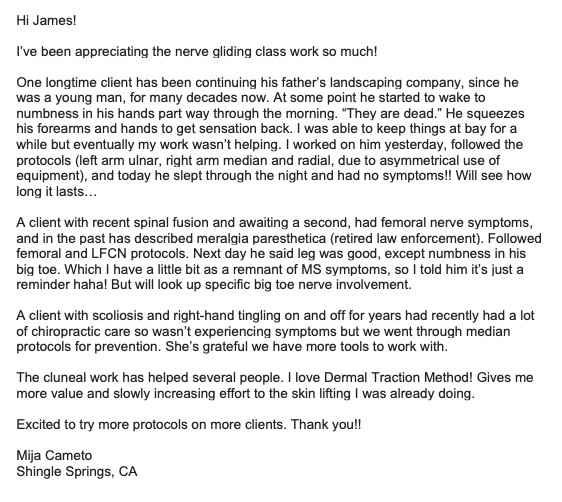
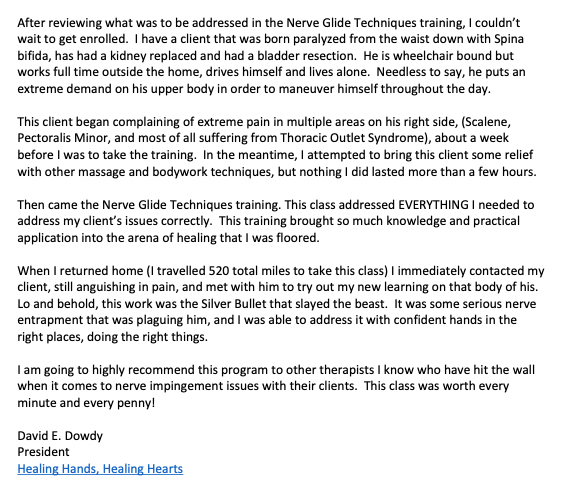
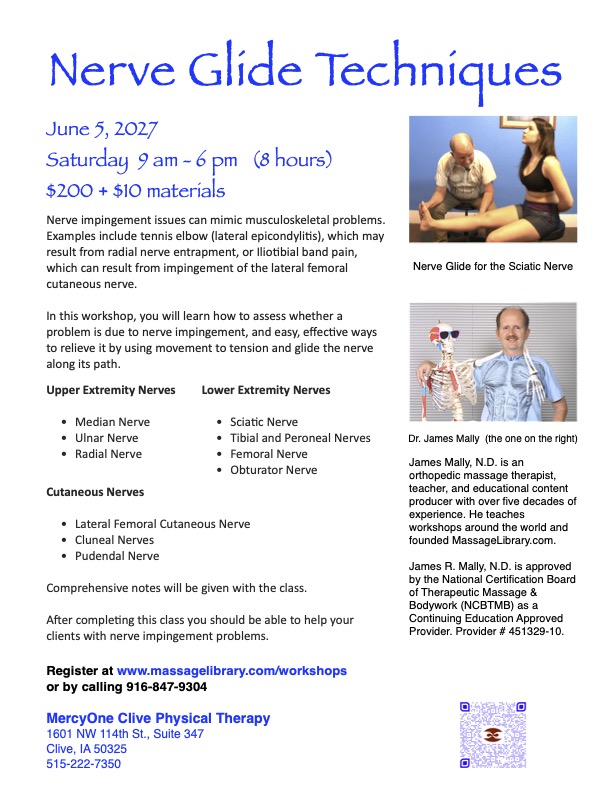
Nerve Glide Techniques – Clive, Iowa

Nerve impingement issues can often mimic musculoskeletal problems. Examples include tennis elbow (lateral epicondylitis), which may result from radial nerve entrapment, and iliotibial band pain caused by impingement of the lateral femoral cutaneous nerve.

In this workshop, you will learn how to assess whether nerve impingement is causing a client’s issue, along with easy, effective ways to relieve it by using movement to tension and glide the nerve along its path.

Key topics covered will include:

– Lower Extremity: Assessing sciatic, tibial, peroneal, femoral, and obturator nerve impingement. We will address impingement in the lower back, piriformis, psoas, and iliacus, followed by neurodynamic assessment and work.

– Upper Extremity: Assessing and differentiating between median, ulnar, and radial nerve impingement syndromes. We will cover brachial plexus impingement areas (nerve roots, scalenes, first rib/clavicle, and pectoralis minor) and perform nerve gliding (neurodynamic work) to move affected nerves through their channels and improve function before reassessing.

– Cutaneous Nerves: Assessing and treating cutaneous nerve impingement with specific pain patterns, including the lateral femoral cutaneous, cluneal, and pudendal nerves.

This class includes extensive notes. After completing the course, you will be equipped to effectively help your clients with nerve impingement problems.

What to Bring: Please bring shorts and, for women, a sports bra or swimsuit top.

For more information, please call 916-847-9304.

Download a flyer to post at your workplace or share with your colleagues.

Click here to register for the workshop.