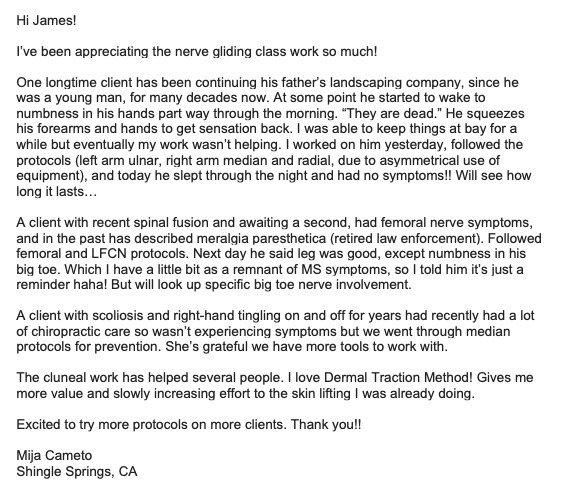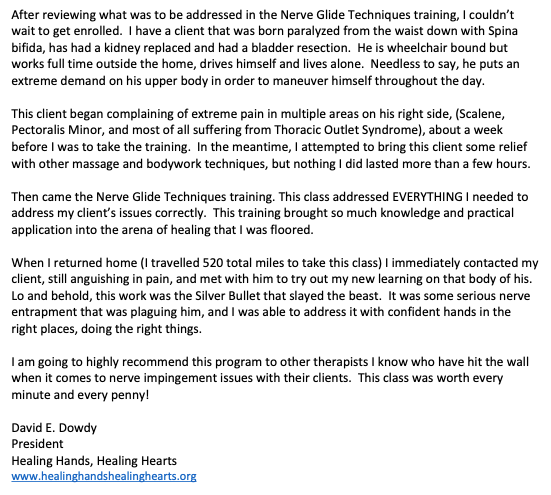



Nerve impingement issues can mimic musculoskeletal problems. Some examples include tennis elbow (lateral epicondylitis), which may be caused by entrapment of the radial nerve, or Iliotibial band tightness or pain resulting from impingement of the lateral femoral cutaneous nerve.
In this workshop, you will learn ways to assess if a problem is from nerve impingement and easy and effective ways to relieve nerve impingement by using movement to tension and glide the nerve along its path.
For the upper extremity, we will cover the assessment of nerve impingement problems, differentiating between median, ulnar, and radial nerve impingement syndromes. We will then work with impingement areas for the brachial plexus, including the nerve roots, scalenes, first rib, clavicle, and pectoralis minor. This will be followed by specific work for impingement areas in the upper extremity for the median, ulnar, and radial nerves. We will follow this with neurodynamic work, also known as nerve gliding, to gently move the affected nerves through their channels and help improve nerve function. We will then reassess to note any improvement that has occurred.
We will perform similar work on the lower extremity, starting with an assessment of impingement problems involving the sciatic, tibial, peroneal, femoral, and obturator nerves. We will work on the lower back, including the piriformis, psoas, and iliacus, before addressing specific areas of impingement that affect the nerves in the lower extremity. We will follow this with neurodynamic work and assessment.
We will also work with the assessment and treatment of impingement of cutaneous nerves that have specific pain patterns, including the lateral femoral cutaneous nerve, cluneal nerves, and the pudendal nerve.
Extensive notes will be given with this class. After completing the class, you should be able to help more of your clients have a greater pain-free range of motion.
Please bring shorts and a sports bra for women.
Download a flyer to post at your workplace or share with your colleagues
Please register online by clicking here, or by calling 916-847-9304.