
Download a PDF file with a description of this technique.
I updated this video on July 17, 2024, to show passive techniques.
Cautions:
All work should be relatively pain-free.
Short fingernails are needed for this technique.
If you are going to work under a client’s clothing, as I did in the video here, it is essential to first explain what you want to do and get their permission. I already had permission from my client for this video.
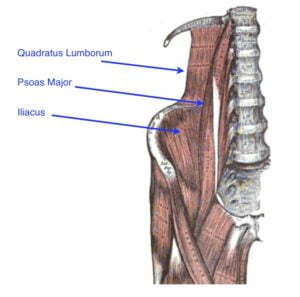
The psoas often gets blamed for what the iliacus does.
When clients have limited hip extension, therapists are quick to blame the psoas. The psoas is a hip flexor, but it also stabilizes the lumbar spine. It is a long, thin muscle.
The iliacus is a much stronger hip flexor, and it can limit hip extension when it is tight. It is often shortened from prolonged sitting. Releasing the iliacus can help clients with limited hip extension and low back pain.
With your client’s hip flexed, press your fingers medial to the crest of the ilium, then pull laterally, catching the iliacus between your fingers and the crest of the ilium. You can work different parts of the iliacus by pressing into different areas medial to the iliac crest. If you press more medially, you may press into the fascia between the psoas and the iliacus.
Have your client push their foot down as you pin the iliacus muscle with your fingers. Go slowly and stay within your client’s comfort range. At the end, have your client dorsiflex their ankle and make their leg long while you press distally on their thigh, tractioning their leg distally.
Variation – Eccentric Contraction
This technique can be more effective by adding an eccentric load to the hip flexors. Do the technique as before, but this time, press on your client’s distal thigh and have them gently resist your pressure as they slide their foot down the table. If this can be done without pain, repeat with increasing pressure and resistance.
Variation – Reciprocal Inhibition
You can also perform this technique with your hand on the distal hamstrings, resisting your client’s efforts to slide their foot down the table. This engages the hamstrings and glutes more, decreasing hip flexor activation through reciprocal inhibition.
I often work with both eccentric contraction and reciprocal inhibition, then inquire of my client which method feels best for them.
Rocking – Making Nice
After performing this technique, continue pinning the iliacus muscle while gently rocking your client’s leg medially. The psoas and iliacus do lateral rotation of the femur, so the medial rotation of the rocking will stretch these muscles. The rocking is also soothing and relaxing after doing the pin-and-stretch work.
You can also have your client actively rotate their femur as you pin both the iliacus and tensor fascia lata.
I suggest trying these different techniques and working with what feels best for your client.
Related Techniques:
Lateral Femoral Cutaneous Nerve Glide
Sartorius – Soft Tissue Release
Psoas and Iliacus – Trigger Point
Psoas Stretch Sidelying – Facilitated
Psoas PNF Stretch (from Deep Tissue Massage DVD)
Psoas PNF Stretch (from Sports Massage DVD)
Look up Psoas using the search function to see more Psoas techniques.